A Rhode Island license plate has carried the same idea since 2023. The design uses a white reflective background, navy blue lettering, a small wave pattern and the anchor that has marked state plates for decades. The current Ocean State design replaced the long-running Wave plate and appears on passenger cars, trucks, trailers and motorcycles, with different lettering colours and formats for each class. Every class uses those same two colours, but the character count, the renewal cycle and the fee change with the vehicle.
This page covers the plate itself and the practical jobs that follow it, including which plate type fits your vehicle, what the DMV charges, how registration and renewal work, what changed for front plates in 2026, and where the official forms live. Every fee below comes from the Rhode Island Division of Motor Vehicles, not from a reseller. Figures are current for 2026 and match the published DMV tables.
How to get a Rhode Island license plate
New plates come with a new registration. You cannot buy a plate on its own, and you cannot transfer a plate from another state, so the sequence starts with the vehicle and ends with the plate. Timing matters more than most buyers expect. A private sale completed on a Saturday cannot be registered until the next working day, and the seller’s plates come off as soon as the title changes hands. Insurance has to be active before the appointment, not after it, because the DMV checks coverage while the record is open.
- Get proof of ownership: A signed title from the seller, or a Manufacturer’s Certificate of Origin for a new vehicle, plus a bill of sale.
- Complete a VIN check: The DMV runs this before registration on out-of-state and rebuilt vehicles.
- Arrange Rhode Island insurance: The policy must be active in your name before the registration is issued.
- Pay sales tax: Tax is collected at registration on the purchase price.
- Register the vehicle: Book and attend the Cranston headquarters, or use a participating AAA branch.
- Collect the plates: Standard plates are issued at the counter. Vanity and specialty plates are ordered and mailed or collected later.
Registration runs for two years on a passenger vehicle. Your renewal month is set by the first letter of the registered owner’s last name, or by the company name for business vehicles, so two cars bought on the same day can renew in different months.
Three DMV pages cover the whole sequence:
- New registration: https://dmv.ri.gov/registrations-plates-titles/registration/new-registration
- VIN check: https://dmv.ri.gov/registrations-plates-titles/registration/vin-check
- Moving to Rhode Island from out of state: https://dmv.ri.gov/registrations-plates-titles/registration/moving-ri-out-state
What to bring to the counter
Bring more than you think you need. The counter accepts a signed title, a bill of sale, proof of Rhode Island insurance, the VIN inspection slip where one applies, and payment for tax and fees. A lease adds the lease agreement and a power of attorney from the lessor. Missing one document usually means a second trip, and appointments in Cranston fill fast at the end of the month.
What registration actually costs
Budget for three separate charges rather than one. Sales tax is calculated on the purchase price, registration is calculated on weight and prorated to your renewal month, and the plate itself is a flat fee. A used car bought privately in July costs less to register in September than in January because the first registration is prorated to the next renewal date.
Moving in from out of state
New residents have a limited window to transfer a title and register, and the out-of-state plate must come off once the Rhode Island plate is issued. Keeping both registrations active is not allowed.
Appointments and dealer paperwork
Appointments are the bottleneck rather than the paperwork. Cranston releases slots on a rolling basis, and the AAA branches that handle registrations book separately. A weekday morning in the middle of the month is usually easier than the last week, when renewals and new registrations collide. If you are buying from a dealer, the dealership can submit the registration for you and hand over the plates at delivery, which removes the visit entirely.
What the current Rhode Island license plate looks like
The plate in production today is the result of a public design contest run by the Rhode Island Department of Revenue. The winning entry came from Willem Van Lancker of South Kingstown and went into distribution in 2023, ending a design that had been on the road since 1996.
What changed from the Wave plate
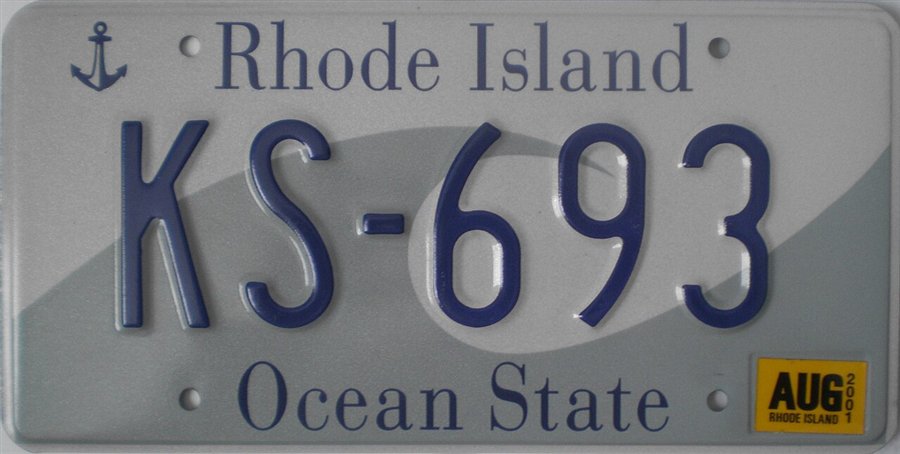
Three details separate the new design from the old one. The wave is smaller and sits lower, the anchor is centred and simplified, and the state name is screened in a tighter, darker font. The background stays reflective white, the characters stay navy blue, and the slogan at the bottom still reads Ocean State.
Why the colours stayed the same
The plate is stamped aluminium with a reflective sheeting applied over it, so the white background throws light back at headlights while the navy characters stay readable in daylight. That contrast is why the state keeps the same two-colour scheme across every redesign, a reflective white plus a dark blue that survives ten years of road salt and car washes without fading into grey.
Rhode Island license plate types
The DMV issues eight main plate classes. The class decides your renewal cycle, your fee, and whether the plate can be transferred later, so it is worth checking before you register. Most drivers only choose between passenger, commercial and combination, but the smaller classes matter for trailers, motorcycles and campers, and each one carries its own renewal date.
| Plate type | Who it is for | Renewal |
|---|---|---|
| Passenger | Sedans, SUVs, wagons, passenger vans | Every 2 years |
| Commercial | Pickup trucks, heavy trucks, cargo vans | Annually, in March |
| Combination | Vehicles that could be registered commercial, up to 8,800 lbs GVWR | Annually, in March |
| Trailer | Commercial trailers (annual, March) and non-commercial trailers (2 years, April) | 1 or 2 years |
| Motorcycle | Motorcycles and scooters | Every 2 years, $47.50 |
| Antique | Qualifying antique vehicles | Varies by plate |
| Public | Municipal, state and public-service vehicles | By agency |
| Camper | Camping trailers and recreational vehicles | Varies by class |
Passenger, commercial and combination
Combination plates are the ones people ask about most. They exist for a vehicle that could legally be registered as commercial but is used privately, capped at 8,800 lbs gross vehicle weight under RIGL 31-3-64. If you drive a heavy pickup and do not use it for business, that is usually the class you want.
Three questions settle the choice:
- Is the vehicle used to carry goods or tools for payment? Commercial.
- Is it a heavy pickup or van used privately? Combination.
- Is it a car, SUV or passenger van? Passenger.
Motorcycle, trailer and camper
Motorcycle plates are the smallest in the set and use a shorter format, with two to five characters on a vanity plate against two to six on a passenger car. They renew at a different rate, with no weight component. Trailer plates split by use. Commercial trailers renew annually in March, non-commercial trailers every two years in April. Camper plates cover camping trailers rather than the tow vehicle, priced by weight like a trailer, with a renewal date that follows the trailer class rather than the car pulling it.
Antique and public plates
Antique plates are issued to qualifying old vehicles and come with restricted use, which is why they are cheap to keep and awkward to drive daily. Public plates belong to the agency, not the driver, and return to the state when the vehicle is retired. The commercial fisheries plate is a separate design issued to licensed fishing operations, and it is one of the few Rhode Island plates that requires proof of an occupation rather than just a vehicle class.
Can you still get a vanity plate in Rhode Island?
No. The DMV states plainly on its vanity plate page that it is not currently accepting new applications. The programme stopped in February 2021 after a federal court ruling on the state’s ban on offensive combinations, and five years later the application window has not reopened. The freeze is the most misunderstood fact about Rhode Island plates. National generator sites still show availability checkers and cost calculators, and drivers still arrive in Cranston expecting to order a combination the same day. That has not been possible since the programme closed.
Why the programme stopped
It did not close over money or demand. It stopped because the state’s ban on offensive combinations was challenged in federal court, and Rhode Island lost. Rather than publish a new approval standard immediately, the DMV suspended intake. Every year since, the pause has been extended while the rules are rewritten, which is why no reopening date has been announced.
What it costs when it reopens
If the programme reopens, the mechanics are already published. Orders go through the state’s online vanity plate service, open to passenger vehicles, motorcycles and commercial vehicles under 9,001 lbs. A passenger plate can be any combination of two to six letters, or up to six letters and numbers. Motorcycle plates run two to five characters.
What happens to existing vanity plates
Existing plates are unaffected by the freeze. If you already hold one, you renew it like any other registration and keep the number, and the plate can be transferred when you change cars. What you cannot do is order a new combination or start the process for the first time.
Rhode Island license plate fees
Plate fees are separate from registration fees. Registration is charged by vehicle weight and prorated by date, while plate fees are flat and appear in the DMV’s published plate table. The table below lists those fixed charges, and the section after it covers what the renewal surcharge adds on top.
| Item | Fee |
|---|---|
| Vanity plate, Ocean, passenger (initial) | $69.50 |
| Vanity plate, Sailboat, passenger (initial) | $83.50 |
| Vanity plate, Ocean, motorcycle (initial) | $43.50 |
| Vanity plate, Ocean, commercial under 9,001 lbs | $69.50 |
| Vanity renewal, passenger (2 years) | Registration + $120 |
| Vanity renewal, motorcycle (2 years) | $115.50 |
| Charity plate, initial order | $43.50 |
| Charity plate, remake | $33.50 |
| Standard plate remake | $33.50 |
| Sailboat plate, passenger or commercial | $48.50 |
| Plate change, one plate | $23.50 |
| Plate change, two-way | $43.50 |
| Duplicate registration | $20.50 |
| Farm plate | $19.50 + $10.00 DOT |
What renewal adds
The vanity surcharge is added to the normal two-year registration charge, not charged instead of it, so a vanity plate on a mid-weight car renews well above the standard rate. Motorcycle vanity renewal is fixed because there is no weight component to add. Remakes are the cheapest transaction on the list. If a plate is bent, delaminating or has lost its reflectivity, a remake replaces it without changing the registration or the number. Registration itself follows a different table, based on weight, with an annual DOT surcharge and a separate EV fee. Both are published as separate DMV tables. A first registration usually lands between the cost of the plate and the cost of the tax. On a mid-weight used car, the registration and plate together stay in the low hundreds, while the sales tax on the purchase price is the largest line on the receipt. Budgeting for the plate alone understates the bill by a wide margin, which is why the DMV publishes the tax and registration tables separately from the plate table.
Rhode Island compared with neighbouring states
Two questions decide most cross-border confusion. Does the state require a front plate, and can you personalise one? Rhode Island sits in the stricter half of New England on the first and the closed half on the second.
| State | Front plate | Vanity plates |
|---|---|---|
| Rhode Island | Required, unless the vehicle was built without a front bracket | Closed to new applications since February 2021 |
| Massachusetts | Required | Available |
| Connecticut | Required | Available |
| New Hampshire | Not required | Available |
Registration and title history across the border
Moving between the four states changes more than the plate. Registration cycles, inspection rules and title branding all differ, and a vehicle titled in one state keeps that history when it moves. A car with a rebuilt title in Connecticut does not become clean because it is registered in Rhode Island.
Front and rear plates after the 2026 change
Rhode Island General Law 31-3-18 has long required one plate on the front and one on the rear. A change that took effect on 18 August 2026 created an exemption for vehicles manufactured without a front mounting bracket.
Who qualifies for the exemption
The exemption is tied to the vehicle, not the driver. If your car left the factory with a bracket, you still need the front plate. If it did not, you can legally run the rear plate alone, and no additional paperwork is required at registration.
In practice, that covers most cars in three cases:
- The manufacturer never fitted a front bracket or drilled the bumper
- The model was designed for rear-plate-only markets and sold unchanged in the US
- The mounting point is blocked by bodywork rather than a removable panel
Dealers and buyers should check the build sheet rather than guessing from the bumper.
Tolls, readers and enforcement
Tolling and plate readers are the practical argument in the other direction. The Newport Pell Bridge and the Sakonnet River Bridge read plates rather than transponders for drivers without E-ZPass, and a missing front plate halves the number of reads a gantry can attempt. Drivers have reported missed reads turning into violation notices, which then require a hearing to clear.
Renew, replace or transfer a plate
Most plate admin happens without a visit to Cranston, but each job carries its own fee. Four jobs cover almost everything owners need. They are renewing a registration, replacing a lost or damaged plate, moving a plate to another vehicle, and cancelling a registration when a car leaves your name. Each has its own form and turnaround, and the order in which you do them decides whether you pay once or twice.
Renewal and late renewal
Passenger registrations renew every two years. Renew online or by mail using the notice, and keep the plate. A late renewal does not cancel the registration on the day it expires, but driving past the grace period carries a higher penalty than paying on time, and reinstatement can require proof of insurance and a trip to Cranston.
Lost, stolen or damaged plates
Report a theft to police, then request a remake. The registration number does not change, and a duplicate registration document is a separate charge. Timing is the part that matters. A stolen plate should be reported to police before anything else, because the report number is what protects you when the plate turns up on a toll gantry or a parking ticket in another city. Once the plate is reported stolen, the DMV can cancel it and issue a replacement, and the old number stops being yours. Damaged plates follow a quieter route. A bent, cracked or delaminating plate is handed back at Cranston when the remake is collected, and the registration keeps the same number.
Transfer and cancel
Plates can move with you when you replace a car, provided the registration stays active and the class matches. Cancelling matters as much as transferring. When a vehicle is sold, scrapped or moved out of state, the plate and registration should be cancelled so that tolls, tickets and insurance verification stop following the seller. Insurance lapses are the hidden cost. Rhode Island verifies coverage electronically, and a lapse triggers a registration suspension notice even when the car is parked and unused. Surrendering the plates before cancelling insurance avoids the reinstatement fee that follows.
Looking up a Rhode Island plate
There are two different jobs, and mixing them up wastes money. One checks a registration you already own. The other checks a vehicle you are thinking of buying. The first is free and official, the second is commercial and draws on insurance and title records. Picking the wrong one either returns nothing or charges you for information the state would have given away.
The state registration check
The state tool at ridmvservices.ri.gov checks the status of a registration already on record, which is what you need after a renewal or before a traffic stop. It does not return an owner name.
Vehicle history reports
A commercial lookup takes a plate number, resolves it to a VIN and sells a record drawn from NMVTIS data. None of them are official, and none can legally show you a Rhode Island owner’s name. A report is only as good as the VIN behind it. Plates get swapped between cars, cloned by someone driving a similar model, or left on a vehicle that was sold twice, so the number on the bumper is a starting point rather than proof. Matching the VIN on the dashboard, the door jamb and the title catches most of those cases before money changes hands.
What you can legitimately obtain is the vehicle, not the person:
- Title brand and salvage history
- Lienholder and odometer readings
- Reported accidents and total-loss records
- Previous state registrations
For a used car, the plate is a starting point and the VIN is the record that matters. Rhode Island releases registration data to law enforcement, insurers and certain government users, not to the public, so a search that claims to reveal an owner name is either pulling from an unrelated breach or inventing the result. What a report covers is the paper trail: title brands such as salvage, rebuilt, flood or lemon, odometer readings by year, lienholders, and reported accidents or total losses. What it does not cover is the person.
Low-number and charity plates
Two categories sit outside the standard system. One is numbers that carry social value, the other is designs that raise money for a charity. Neither changes how the car is registered, but both change what other drivers read into the plate.
Low number plates
Rhode Island treats a low plate number as a status symbol in a way few states match. Numbers below 5,000 carry social weight, and low-digit plates pass between family members and appear at auction. How they move, and what to check before paying a premium for one privately, is worth knowing.
Charity plates
Charity plates work the other way, since anyone can order one and part of the money goes to the organisation. The DMV lists every design in production, from the Atlantic Shark Institute plate to Rose Island Lighthouse, Rocky Point and Gaspee Days. Initial orders and remakes are priced separately, and both appear in the fee table.
Plate frames, covers and legibility
Accessories are where most plate trouble starts. A frame or cover that hides a character is a stop, and a plate held on by two bolts is a replacement waiting to happen. The rules are about legibility rather than taste. What matters is whether the state name, the number and the renewal sticker can be read from a normal angle at a normal distance. Frames that wrap the plate edge are the usual culprit, and dealership branding is the most frequent example.
Frames and covers
A frame is legal in Rhode Island as long as it does not cover the state name, the plate number or the renewal sticker. Dealership frames that wrap the bottom edge usually hide part of the slogan, which is a stopping offence even though the frame itself is sold everywhere.
Mounting and replacement
A plate screwed into a bracket with two bolts instead of four rattles, cracks at the holes and eventually loses a corner. A replacement is cheap next to the hassle of a plate that falls off on the highway. If the front bracket was never fitted, the 2026 exemption covers you, but the rear plate still has to be mounted square, at the height the factory intended, with the sticker visible.
Frequently asked questions
These five questions come up most often at the Cranston counter and in messages sent to this site. Each answer is short and specific, and where a rule has an exception the exception is named rather than smoothed over. The figures quoted match the fee table earlier on this page.
How many characters are on a Rhode Island license plate?
Standard passenger plates carry six characters, usually a mix of letters and digits, and that count has not changed with the 2023 redesign. Vanity plates follow different limits, allowing two to six letters on a passenger vehicle or up to six letters and numbers mixed, and two to five on a motorcycle. Spaces, hyphens and symbols never form part of the number.
Does Rhode Island require a front license plate in 2026?
Yes, with one exception. Vehicles manufactured without a front mounting bracket are exempt under the change that took effect on 18 August 2026, and the exemption follows the vehicle rather than the driver. A car that left the factory with a bracket still needs both plates, while a model built for rear-plate-only markets can run the rear plate alone.
Can I order a vanity plate in Rhode Island right now?
No. The DMV stopped accepting new vanity applications in February 2021, after a federal court ruling on the state review of offensive combinations, and has not reopened the programme. No waiting list has been published. Existing vanity plates can still be renewed and transferred with an active registration.
How much does a Rhode Island vanity plate cost?
Initial cost varies by design and vehicle class, with the optional Sailboat design priced above the standard Ocean plate. Renewal adds a vanity surcharge to the normal two-year registration fee rather than replacing it, so the plate costs more to keep than to order. The exact figures sit in the fee table above.
How long does a Rhode Island registration last?
Two years for passenger vehicles, with the renewal month set by the first letter of the registered owner’s last name rather than the purchase date. Commercial and combination plates renew annually in March, trailers follow their own class, and motorcycles renew every two years. A lapsed registration can be reinstated, but a cancelled one returns the plate.