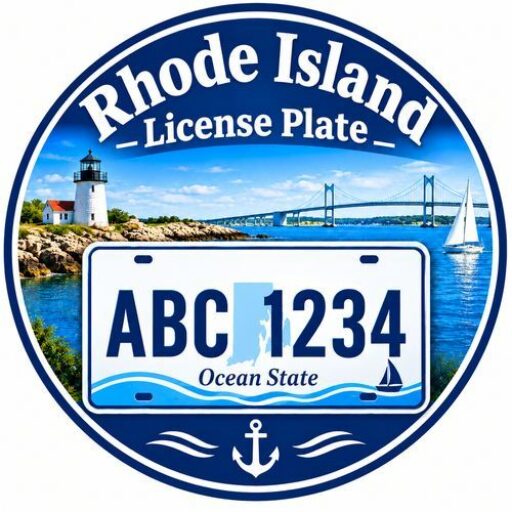
Rhode Island has issued the same basic plate since 2023, and it is easy to recognise once you know what to look for. The design pairs a small wave with a centred anchor, prints the state name in condensed capitals and keeps the slogan along the bottom edge. What follows is how to tell it apart from the plate it replaced, why it was chosen, and which older issues still turn up in traffic.
The change was more than a redraw. A public contest put the decision in front of residents, a designer from South Kingstown won it, and the result went into production across the passenger fleet. The materials did not change, the two colours did not change, and the six-character layout did not change either. That continuity is deliberate, because a plate has to stay legible to cameras, toll readers and the person writing a number down at a junction.
How to identify the current Rhode Island plate design
Start at the bottom edge. The current Rhode Island License Plate carries a narrow wave running low across the face, a centred anchor rising behind the characters, and the slogan Ocean State printed beneath it. The state name sits at the top in condensed capitals. A plate showing all four of those features, on a reflective white ground with navy characters, is the 2023 issue.
Official source: https://dmv.ri.gov/registrations-plates-titles/license-plates/plate-types Position is the fastest test. On the plate in production today the wave stays inside the lower third and leaves most of the face white, while the anchor is centred between the character groups rather than pushed to one side. Older issues put far more graphic on the plate, so the amount of white space is a reliable signal at a distance.
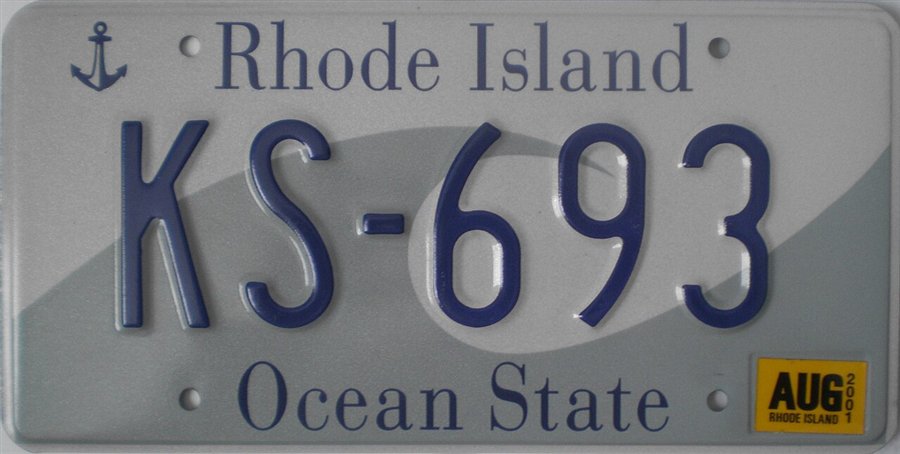
The character layout helps at close range. A standard passenger plate carries six characters in navy, and the number sits between the state name and the slogan without a box around it. A plate with a different count, or with a design element interrupting the characters, belongs to another class or to an earlier series rather than to the current passenger issue.
Current design and the Wave plate compared
Two plates have shared Rhode Island roads since 2023, and the difference is a matter of weight rather than subject. Both carry a wave, an anchor and the same slogan. The table sets the two side by side, so a plate seen at a distance, or photographed in a car park, can be dated without reading the registration sticker in the corner.
| Feature | Current 2023 | 1996 to 2023 |
|---|---|---|
| First year of issue | 2023 | 1996 |
| Wave | Narrow, drawn low along the bottom edge | Larger, covering much of the lower face |
| Anchor | Centred between the character groups, simplified | Larger and more detailed |
| State name | Condensed capitals across the top | Wider capitals across the top |
| Slogan | Ocean State along the bottom | Ocean State along the bottom |
| Background | Reflective white | Reflective white |
| Characters | Navy blue, six on a passenger plate | Navy blue, six on a passenger plate |
| Overall impression | Quieter, with more white space around the number | Busier, with the graphics competing for attention |
The comparison is useful when buying a used car with plates attached, or when a photograph is the only evidence available. A 1996 plate that is still legible remains valid while its registration is current, so the older design is not a sign of an expired record. It is simply an older issue on a car that has not needed a new one.
The public contest behind the 2023 plate
The design did not come from a state office. The Department of Revenue ran a public competition and invited residents to submit artwork for the plate that would carry the state through the next generation of cars. That process is unusual among the states, most of which redraw plates internally or through a contracted design firm, and it made the outcome a matter of public argument before a single plate was stamped.
The brief
A competition of that kind starts with constraints rather than with art. A plate also has to leave room for six characters, a state name and a slogan without crowding any of them, which rules out most of what looks good on a poster. The working conditions are the first filter.
- At night: The plate is read under headlights rather than daylight.
- At speed: A toll gantry captures it in motion.
- In a photograph: An enforcement camera has to be able to use the frame.
The winning entry
South Kingstown resident Willem Van Lancker submitted the entry that won, and the division put it into distribution during 2023. His artwork kept the elements residents already associated with the state, the wave and the anchor, and removed the visual noise around them. The result reads as a quiet plate rather than a promotional one, which is why it has aged well against changing car colours.
What a public contest settles
A public process settles more than a picture. It establishes that the plate belongs to residents rather than to a department, and it makes a later change harder to justify without a similar exercise. Whether that precedent holds for the next redesign is an open question, but the expectation now exists and any future department will have to answer it.
What changed from the 1996 Wave plate
The 1996 plate and the 2023 plate share a subject, not a composition. The older design gave the wave most of the lower face and rendered the anchor at a larger scale, so the two graphics competed with the number. The current issue reduces both, lowers the wave and centres the anchor, which returns the middle of the plate to the characters where it belongs.
The wave
The wave shrank and dropped. In the current layout it occupies a narrow strip along the bottom edge, leaving the centre of the plate white and the number unobstructed. On the 1996 plate the same motif covered a much larger band, which looked dramatic on a wall but made a six-character read harder at forty metres on a wet night.
The anchor
The anchor moved to the centre and lost detail. A centred anchor sits in the gap between the character groups, so it no longer crowds the first or the last digit. Simplifying it also helped at small sizes, where fine line work disappears into the background and leaves a smudge rather than a symbol, particularly on a plate that has spent a decade in the sun.
Type and slogan
The state name is set in condensed capitals across the top, tighter and darker than the lettering it replaced. Ocean State remains along the bottom, with the wording untouched. Keeping the words and changing only their weight is what makes the new plate recognisable without making it look as though it belongs to a different state.
Colours, reflectivity and materials
The palette did not change, and that is the point. All plate types in general issue use navy characters on a white ground, a pairing chosen for contrast rather than for fashion. The white is a reflective sheeting rather than paint, so it returns light to a camera or to a driver’s headlights instead of absorbing it, which is what makes an unlit plate readable at night.
The two-colour rule
Two colours, one dark and one light, is the cheapest way to guarantee legibility. Adding a third costs money at every stage, from the artwork to the print run, and it rarely improves a number read from a moving car. The wave and the anchor are drawn in the same navy as the characters for that reason, and so is every other element on the face.
Sheeting and stamping
The plate begins as aluminium, stamped with the character shapes and then covered with reflective sheeting that carries the printed design. The sheeting is what ages first. Sun, road salt and repeated washing dull the surface, and a plate that has gone chalky white will defeat a reader long before the metal itself shows any damage or delamination.
Front and rear plates
Rhode Island requires a plate at both ends of a passenger vehicle, and both carry the same design and number. From August 2026 a vehicle built without a front mounting bracket is exempt from the front requirement, which means a single plate on some cars is lawful rather than a missing part at a roadside check.
Reading the design at a distance
The plate is built to be identified at speed, not admired at rest, and the 2023 layout reads more cleanly from twenty metres than the plate it replaced. The wave sits below the character line, the anchor interrupts nothing, and the number occupies the middle band on its own. That arrangement is why a toll camera or an enforcement reader captures the current issue more reliably than the older, graphic-heavy version.
Contrast under headlights
At night the plate is lit by whatever the following car provides, which is why the reflective ground matters more than the ink. Navy on white returns a strong edge, and the sheeting bounces light back along the path it arrived from. A design that adds mid-tones between those two extremes softens the edge and makes a character look wider or narrower than it really is.
The sticker corner
Registration stickers sit in a marked corner of the rear plate, and the current design keeps that area clear of artwork. On the older plate the wave ran into the same corner, so a sticker could cover part of the graphic and leave an uneven edge. A clean corner is not decorative. It is where the evidence that the registration is current actually lives.
Older series still on the road
A redesign does not recall the plates already issued. A 1996 Wave plate stays valid for as long as its registration is current, and the same is true of earlier issues that were never surrendered. That is why a car park in Providence can hold three generations of plate at once, all legal, all carrying different artwork and the same six-character layout.
Wave plates in circulation
The 1996 design is still frequent, particularly on vehicles that have stayed with one owner. It is not a collector’s item yet, but it is old enough that a clean example stands out. Nothing obliges an owner to swap it for the current issue, and the registration record does not change when a plate is replaced voluntarily rather than through damage.
Low numbers and earlier issues
Low-number plates carry local status in Rhode Island, and any number under 5,000 is treated as a mark of standing rather than a random draw. Those plates are often held for decades and moved between vehicles, which is why an old design can sit on a new car. The artwork ages. The number is the part that carries the value.
When a plate is replaced
A plate is replaced when it is damaged, when it has faded past reading, or when the owner chooses a new design. A replacement keeps the registration and the number unless the owner asks for a change. The old plate goes back to the state, and reissuing the same combination later depends on whether it has already been reassigned to another vehicle.
The Sailboat plate and other optional designs
Not every Rhode Island plate carries the wave. The Sailboat design is the best known alternative, and it replaces the wave and anchor with a sailing scene while keeping the same reflective white ground and navy characters. It is ordered as an option rather than issued by default, so most cars on the road still carry the standard artwork.
The Sailboat option
The Sailboat plate is a passenger design chosen at the point of registration or added later as a plate change. It shares the six-character layout and the slogan with the standard plate, so a reader who knows the format can still parse it at a glance. The difference is the illustration, not the numbering system behind it.
Antique and charity designs
Antique plates and the charity series sit outside the standard artwork entirely. Those antique plates follow their own layout for vehicles of qualifying age, and each charity design carries the organisation’s emblem alongside the state name. Both are produced on the same base plate, which is why they fade and age in the same way as the standard issue.
How a design reaches production
Between a winning drawing and a plate on a car there is a manufacturing stage that changes almost everything about the artwork. Line weights that read well on paper disappear when stamped into aluminium. Colours that look distinct on a screen merge under a streetlight. The design that survives is the one that still works after both translations, which is why the current plate is simpler than the entry that produced it. Production also sets three variables, and a design with tight margins around the artwork will show every one of them. A design with white space absorbs the error instead, which is why the current plate keeps its white space exactly where the process is least precise. The variables are fixed before the first plate is stamped.
- The number of colours: The run is built around a fixed palette.
- The position of the characters: The layout has to survive being stamped into aluminium.
- The tolerance for registration error: The small misalignment between one printed layer and another.
Telling a current plate from a copy
Reproduction plates are sold for display, and some are convincing in a photograph. The differences show up in the details rather than in the overall picture. A genuine plate has characters that catch the light at an angle, a ground that returns a camera flash, and a registration sticker applied in the marked corner. A flat print has none of the three. The wave is a useful check as well. On a real plate it follows the curve of the stamped surface and stays inside the margin, while on a copy it is often printed hard to the edge and repeats the same line weight everywhere. None of this matters for a decoration on a garage wall, but it matters when a plate is offered together with a vehicle.
What the design does not change
A new plate is a new picture, not a new system. The number of characters on a passenger plate, the classes that exist, the renewal cycle and the record behind the plate all stayed as they were when the artwork changed. Owners sometimes assume a 2023 plate means a new registration or a new number, and neither of those follows from the design on its own.
Classes and layouts
Commercial, combination, motorcycle, trailer and camper plates keep their own layouts and their own character counts. The wave and anchor are adapted to those formats rather than pasted onto them, which is why a commercial plate does not look like a stretched passenger plate. The design language is shared, while the proportions are not.
Renewal and the plate itself
A renewal does not replace the plate. It adds a sticker and extends the record, so a car registered for years can still be carrying the design it was issued with, however old that design happens to be. Replacing the plate is a separate transaction, usually prompted by damage or by an owner who wants the current artwork on the car.
Frequently asked questions
These are the questions that come up when a plate is photographed, dated or compared with the one on the next car. The answers describe what can be seen on the plate itself rather than quoting a registration record, because the design is the same across classes even where the number of characters and the renewal cycle are not.
When did the current Rhode Island plate design appear?
The division put it into distribution in 2023 after a public contest run by the Department of Revenue. South Kingstown designer Willem Van Lancker won the competition, and his artwork replaced a plate that had been issued since 1996. Nothing on the road was recalled when the change happened.
How can I tell the 2023 plate from the older Wave plate?
The wave is the clearest signal. On the current plate it is narrow and sits along the bottom edge, leaving most of the face white. The older plate gives the wave a much larger band and renders the anchor at a bigger scale, so the graphics compete with the number.
Who designed the current Rhode Island license plate?
Willem Van Lancker of South Kingstown, who won the public competition run by the Department of Revenue. His entry kept the wave and the anchor, which residents already associated with the state, and removed the detail that had crowded the number on the previous issue.
Can I keep an older plate on my car?
Yes. A plate stays valid while the registration attached to it is current, and there is no requirement to swap to the 2023 design. Many vehicles still carry the 1996 issue, particularly those that have stayed with a single owner since new.
Is the Sailboat plate part of the same series?
It is a separate optional design rather than a variant of the standard artwork. The Sailboat plate keeps the reflective white ground, the navy characters and the six-character layout, but replaces the wave and anchor with a sailing scene chosen by the owner.