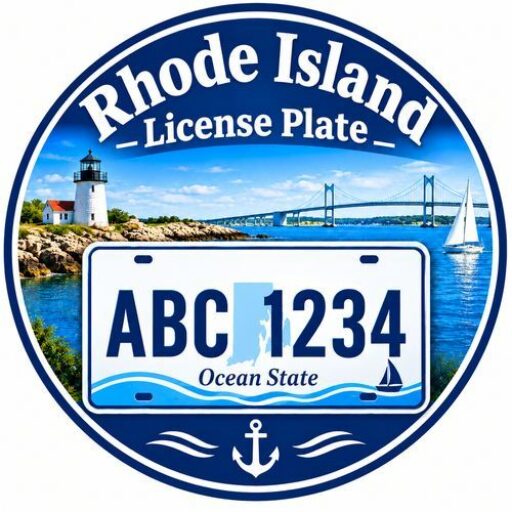

A low number plate in Rhode Island is an ordinary passenger plate carrying an unusually early number from the state’s original series, generally anything below 5,000. It is not a special product, it is not sold from a catalogue and there is no application form for one. It reaches a driver by coming attached to a vehicle that already holds it, which makes the used-car market the only real route to one.
That scarcity is what gives the number its weight. Rhode Island drivers read a three-digit or four-digit plate as a sign that the car, or the family that owns it, has been in the state for a long time. What follows covers how the transfer works, why the number cannot be separated from the registration, what to check before money changes hands, and how the practice sits against the vanity programme.
How to get a low number plate in Rhode Island
There is no queue to join and no list to add your name to. A low number arrives with a vehicle, or with a registration transferred inside a family, and the division records the change rather than issuing a new number. The sequence of events is therefore a vehicle transfer first and a plate transfer second, never the other way round.
What a low number actually is
The current passenger series issues six characters, and the earliest plates were numbered in a simple ascending sequence. Anything under 5,000 belongs to that early run, which is why a Rhode Island License Plate reading 842 or 3,117 looks different from a modern issue. The number is old metal rather than a product, and the division treats it as part of the registration record attached to the vehicle.
Buy the vehicle, not the number
The only reliable way to acquire a low number is to buy a vehicle that already carries one and keep the registration alive through the sale. A seller who offers the number on its own is offering something the division does not sell. Treat any arrangement where the plate is handed over separately from the car as unenforceable, because the number follows the registration and not the other way round.
Through a family transfer
Numbers often stay in a family for decades, passing from a parent to a child when a car is handed on. The registration transfer is the mechanism, and the plate moves with it once the division records the new owner. Confirm the class and the insurance before the transfer is submitted, because a break in the registration is the one event that can send the number back to the pool.
At a dealer or in a private sale
A dealer selling a car with a low plate will normally transfer the registration as part of the sale, and the plate stays on the vehicle. A private sale depends on the buyer and seller completing the transfer rather than on the dealership’s paperwork. Ask which of the two is happening before agreeing a price, since the answer decides whether the number survives the transaction.
Official source: https://dmv.ri.gov/registrations-plates-titles/license-plates/plate-transfers
Why low numbers carry status
Status attaches to scarcity rather than to anything the division publishes. A number below 5,000 is old, and old numbers are finite, so the supply cannot expand to meet demand. That simple arithmetic covers the local regard for a short plate, and it also covers why the value is set privately rather than by a state schedule.
The original series
The first passenger plates were issued in a plain ascending order, long before the current wave and anchor design existed. Numbers from that run have been reissued on modern blanks over the years, so a low number usually appears on current artwork rather than on a period plate. The characters are what carry the history, not the metal they happen to be stamped into.
What counts as low
Under 5,000 is the working threshold, and the lower the number the stronger the effect. A four-digit plate draws comment, a three-digit plate draws more, and a two-digit plate is rare enough to be recognised locally. There is no official register of prestige, and the division does not rank plates or publish a list of desirable numbers.
Reading a short plate on the road
A short number stands out because it breaks the pattern the eye expects. Modern passenger plates carry six characters, so a plate with three or four is instantly distinguishable at a distance and is often remembered after a brief glimpse. That visibility is part of the appeal, and it is also why a low number attracts attention a standard plate never receives.
Why the regard is local
Outside Rhode Island, a short number is simply a short number, and a driver from another state will not read anything into it. The meaning depends on a shared local knowledge of how the state issues plates and how long the series has been running. That is why the value does not travel, and why a plate that is prized in Providence may mean nothing in Boston.
How the number moves with a vehicle
The plate and the registration are one record, and the number cannot be detached from it. Selling the car, transferring the Rhode Island License Plate to a replacement vehicle and cancelling a registration are the three events that decide what happens next. Each one has a different outcome for the number, and the difference is worth knowing before a sale is agreed.
Transferring the plate
A plate transfer moves the registration, the plate and the number together from one vehicle to another in the same class. The division records the new vehicle and retires the old record. The number does not change during the process, and no new sequence is issued. The transfer has to happen while the registration is active, because a lapsed record cannot carry a plate across.
Keeping the registration alive
The most frequent way to lose a low number is to let the registration lapse at the wrong moment. A cancelled registration requires the plate to be surrendered, and a surrendered plate returns to circulation. Renewal on time, insurance kept active and an address kept current are unglamorous habits, but they are what keep an old number on the car rather than back in the queue.
When the number returns to the pool
A surrendered plate goes back to the division and the number can be issued again in the ordinary course of business. There is no reserve, no grace period and no mechanism for a former owner to reclaim it. That is why a buyer should never pay for a number that is not currently attached to a live registration, however convincing the paperwork looks.
Two plates and one number
Passenger vehicles carry a front and a rear plate, and the number appears on both. A transfer therefore involves the pair rather than a single piece of metal, and an incomplete set is a problem at inspection rather than at the counter. If one plate is lost, the replacement is ordered as a remake so that both carry the same characters and the same design.
Low number vs vanity vs standard
Three kinds of plate end up in the same conversation, and only one of them is bought from the state. The comparison below sets out where the number comes from, whether it can move, what it costs to keep and how a driver can obtain one today. The rows are deliberately short, because the differences are structural rather than a matter of degree.
| Plate type | Number source | Transferable | Cost to keep | Availability |
|---|---|---|---|---|
| Low number | Original series, below 5,000 | Yes, with the vehicle and registration | Standard registration charges | Only with an existing vehicle |
| Vanity | Combination chosen by the owner | Yes, when the class matches | Renewal surcharge on the registration | Closed to new applications since February 2021 |
| Standard | State-issued sequence, six characters | Yes, with the registration | Standard registration charges | Issued with any new registration |
The contrast is clearest in availability. A standard plate is issued with any registration, a vanity plate is closed to new applications, and a low number is only obtainable by taking over the vehicle that carries it. Cost follows the same logic. Two of the three renew at the ordinary rate, while the vanity plate carries a surcharge for as long as it is held.
What to verify before paying
A private sale of a vehicle with a low plate is still a used-car purchase, and the plate adds a second layer of risk on top of the usual ones. The checks below are the ones that decide whether the number survives the transaction. None of them is difficult, and all of them are easier before the money moves than afterwards.
The registration matches the seller
The name on the registration has to be the name of the person selling the car, and the plate number on the certificate has to match the plate on the vehicle. A mismatch means the seller is not the registered owner, which turns a simple transfer into a dispute. Ask to see the certificate rather than a photograph of it, and compare both the name and the number.
Title, VIN and liens
The title confirms ownership and the VIN confirms the vehicle, and the two have to agree with the car in front of you. A cloned vehicle can carry a genuine-looking plate, so the check has to be physical. Three records settle the question.
- The title: The name on it has to be the seller’s.
- The VIN: The door pillar and the windscreen figures have to match it.
- Any lien: A lender’s claim has to be released before the transfer can complete.
A written agreement about the plate
Put the plate in the sale agreement even though the division does not require it. The document should record that the registration is being transferred with the vehicle, that the number stays on the car and that the seller will sign whatever the division needs. A verbal promise is worth very little once the car has been paid for and the seller has stopped answering the phone.
Confirm the class and the transfer route
Before paying, confirm that the vehicle is in the class the plate belongs to and that the transfer will be recorded rather than treated as a new registration. A change of class can force a new plate and lose the number, and that is where most plate transfers fail. The division is the only authority on that question, and a phone call before the sale is cheaper than a correction afterwards.
Buying privately
The private market for low numbers is informal, and that informality is where most of the risk sits. There is no published price list, no auction house and no standard contract. Sellers price from local reputation, and buyers judge from the same thing. A few habits make the process safer without pretending it is regulated.
There is no official price
The division does not value low numbers and does not broker them. Any figure in a private sale is a matter between the two parties and reflects nothing more than what a buyer will pay. That means a premium is paid for the car rather than for the plate, and the vehicle should still be worth roughly what it would be worth without the number.
Meet at the division or a branch
Completing the transfer in person at a division office or a participating branch removes most of the ambiguity. Both parties see the record change, the plate is confirmed against the registration and the receipt names the new owner. A sale completed entirely by post or online leaves the buyer relying on the seller to finish a job they no longer have an interest in.
The premium and the risk
A buyer pays a premium for a short number and receives nothing the division guarantees beyond the plate itself. If the registration lapses, the premium goes with it. That asymmetry is the reason to keep the transaction simple, to complete the transfer immediately and to avoid paying a separate sum described as the price of the number alone.
When the seller keeps the plate
Some sellers want the number for their next car, and that changes the deal entirely. If the plate is transferred off the vehicle, the car is sold on a new registration and the buyer receives an ordinary plate. Agree that position in writing before the price is settled, because a number removed after the sale is a loss the buyer cannot recover through the division.
Family transfers
Many low numbers never reach the open market at all. They pass between relatives when a car changes hands, and the transfer is recorded like any other. The family route is gentler on price and harder on paperwork, because the parties often assume that relationship removes the need for the usual stages.
Handing a car to a child or relative
The vehicle is sold or gifted, the title changes hands and the registration is transferred to the new owner. The plate follows the registration, so the number stays on the car. The sales tax position depends on how the transfer is documented rather than on the family relationship alone.
What cannot be passed on
A number cannot be willed separately from the vehicle, and it cannot be held in reserve for a relative who is not yet driving. If the car is sold outside the family or the registration is cancelled, the number goes with it. Planning a transfer therefore means planning the vehicle’s ownership, not filing a claim on the characters.
The paperwork a family transfer still needs
Relationship does not replace a signature. Skipping a stage because the parties trust each other is how a transfer stalls at the counter. The file still needs the following.
- The title, assigned: Signed over to the new owner.
- The registration application: Completed in the new owner’s name.
- Insurance: Confirmed in the new owner’s name before submission.
- A gift letter: May be needed to describe the price.
- An odometer statement: Required on the title for the usual age range.
Why low numbers are not part of the vanity programme
The vanity programme sells a chosen combination and reviews it before manufacture. Low numbers predate vanity plates entirely, and they were never selected by anyone. The distinction matters because drivers often ask whether a short number can be ordered through the vanity route, and the answer follows from how each number came into existence.
Chosen versus inherited
A vanity plate begins with an application and a review, and the driver supplies the characters. A low number begins with a registration issued decades ago and has never been reviewed by anyone. One is a product the state sells, the other is a record the state keeps. That difference is why the vanity freeze had no effect on short plates and why no order form exists for them.
The programme is closed anyway
A federal court ruling on the state’s review of offensive combinations ended new vanity applications in February 2021. Even if a short number could be requested, there is no open channel to request it through today. The low-number market operates beside the programme rather than inside it, which is why it is unaffected by the pause.
What this means for a buyer
A buyer who wants a short plate should look at vehicles rather than at forms. Searching the used market for a car that already carries a low number is the only route that works, and it requires patience because the supply is fixed. Anyone offering a shortcut through an application is describing a process the division does not operate.
Frequently asked questions
The questions below come from buyers who have seen a short plate on a car for sale and want to know whether the number will survive the purchase. Each answer follows the way registrations and plate transfers are administered, rather than the assumptions that circulate in local classified adverts.
Can I request a specific low number from the DMV?
No. The division does not accept requests for a particular short number, and there is no waiting list or lottery. Numbers below 5,000 exist only on registrations that already carry them, so the only way to obtain one is to take over the vehicle and keep the registration active through the transfer.
Does a low number add value to a used car?
It can, in the local market, but the premium is private and undocumented. The division does not publish a value for short numbers, and a lender or insurer will value the vehicle on its make, model and condition rather than on its plate. Treat any premium as a separate negotiation.
Can I keep my low number if I move to another state?
No. The number belongs to a Rhode Island registration, so it comes off when the vehicle is titled elsewhere. There is no provision to hold it in reserve for a future return. A move within Rhode Island does not affect the plate, although the address on the record should be updated.
What happens if the registration lapses?
A cancelled registration requires the plate to be surrendered, and a surrendered plate returns to circulation. Renewing late is better than not renewing at all, but the safest course is to renew on time and keep insurance active. Reinstatement does not guarantee that the original number is still available.
Can I put a low-number plate on a new car?
The plate can move to a replacement vehicle in the same class through a plate transfer, provided the registration stays active. The number travels with the registration rather than with the old car, so a new purchase can keep it. Confirm the class before the transfer is submitted.