A Rhode Island plate number looks like a simple string until you try to read one properly. Six characters, letters and digits mixed, no spaces and no punctuation, printed in navy on a white reflective background. That plain surface hides a set of rules about length, plate class and issue order, and the rules change depending on whether the plate sits on a passenger car, a motorcycle or a light commercial vehicle.
This page covers how the characters are arranged, which parts of a plate the DMV controls, and where the limits sit for each class. It also covers the vanity limits that still apply to personalised plates already in use, the reason spaces and symbols never appear, and the parts of a plate number that people usually mistake for information about the owner or the vehicle.
How to read a Rhode Island plate number
Reading a plate means separating three things that share one rectangle, and most mistakes come from mixing them up. The characters in the main field identify the vehicle, the fixed text along the top or bottom identifies the state, and the small sticker marks the registration month. Only one of those belongs in a lookup field, and only one of them changes when a car is sold.
- The characters in the main field: The plate number.
- The fixed text along the top or bottom: The state name and the slogan.
- The sticker or marker: Whether the registration is current.
Only the characters identify the record, and only they belong in a lookup field.
Official source: https://dmv.ri.gov/registrations-plates-titles/license-plates/plate-types
Read the characters left to right
Start at the left edge and take every character in order, treating letters and digits as equally important. A zero and the letter O are different characters, and so are a one and the letter I. A plate reader matches the exact string, so a transcription that swaps one for the other returns nothing even when the plate in front of you is genuine.
Separate the number from the fixed text
Ocean State is a slogan, not part of the number, and the state name is fixed text on the same blank. Neither changes when the registration changes hands, and neither should be typed into a lookup. The characters that matter are the ones in the series, plus any smaller characters the class prints in a second row.
Why a standard passenger plate carries six characters
Six characters is the published width for a standard passenger plate, and it is a property of the class rather than a choice made per vehicle. The number of positions decides how large the pool of available combinations is, and it also sets how much room each character gets on the blank. A six-character field is long enough for the DMV to keep issuing numbers without exhausting the pool, and short enough to fit the standard plate at a size that stays legible from a distance and through a camera. The count is fixed, so a passenger plate does not arrive with five characters one month and seven the next.
Why the count is not a code
The six positions are not a code with sections for region, year or vehicle type. Nothing in the string is reserved for a date, and the arrangement of letters and digits is not a signal a reader can decode. Treating the pattern as a hidden message produces guesses the record contradicts, and the class remains the reliable label.
Letters, digits and how the sequence is issued
The DMV assigns the number, and the applicant does not pick the combination or the position of the letters. A standard plate arrives with the registration already printed, drawn from the series held for one of the plate types. Passenger plates and commercial plates come from separate pools, so the classes do not compete for the same six characters. Because the pool belongs to the class, the plate type is part of how a plate is described. That is why a lookup form or a counter clerk asks for the class alongside the characters, and why a plate that looks ordinary on a car can be recorded under a category that changes the fee or the renewal date.
What the applicant controls
For a standard issue, nothing about the sequence. The applicant controls the vehicle class, the registration type and the design chosen where an optional design exists. Vanity requests were the one place where a driver chose characters, and that route has been closed to new applicants since February 2021, so choice has largely moved out of the process.
What the DMV controls
The DMV controls the pool, the class assignment, the character set that gets printed and the design that carries the number. It decides when a plate is replaced rather than remade, and it holds the record that links the string to a vehicle. None of that is visible on the plate itself, which is why the same six characters can mean little to a passer-by and everything to the record behind them.
How motorcycle and commercial formats differ
A motorcycle plate is physically smaller than a passenger plate, so it holds fewer characters. That is the practical reason the vanity limit for a motorcycle is 2 to 5 rather than the 2 to 6 allowed on a passenger car. The narrower blank also changes the spacing, which is why a motorcycle number can look cramped when it is copied onto a form laid out for a car. Commercial vehicles under 9,001 lbs sit in a class of their own, with a six-character allowance and a renewal schedule that differs from a passenger car. The characters are not what marks the difference. The plate type, the weight band and the renewal month are what separate a light commercial plate from a passenger one.
Why the classes are not interchangeable
A plate belongs to the class it was issued for. Moving one between a passenger car and a light truck is a transfer question rather than a formatting question, and the DMV decides whether the class allows the move. The characters may stay the same while the record behind them is rebuilt for a new vehicle and a new fee band.
Vanity plate character limits
Vanity plates were the one format where a driver chose the characters, and the limits still describe the plates already on the road.
- Passenger vanity plate: 2 to 6 letters, or up to six characters mixing letters and numbers.
- Motorcycle vanity plate: Shorter, at 2 to 5.
- Commercial vanity plate under 9,001 lbs: Follows the passenger width.
The limits are about legibility rather than taste. A five-character motorcycle combination fills the smaller blank, and a six-character passenger combination does the same on the wider one. Anything longer would either shrink the characters or run past the margin, and both make the plate harder to read in traffic or from a photograph.
The application pause
The DMV stopped accepting new vanity applications in February 2021, after a federal court ruling. Existing vanity plates continue to renew, and the character limits still apply to them. A new applicant cannot currently order a combination, so the rules matter mainly to drivers reading or renewing a plate that was issued before the pause.
Reading an existing vanity plate
A vanity plate is read like any other, left to right, with no spaces. What differs is that the characters were chosen rather than assigned, so the string may spell a name, a word or an abbreviation. The plate type still has to be recorded correctly, because the same letters may exist in a different class with a different record.
Why spaces and symbols never appear
A plate is a fixed-width field, and every position has to hold one character from a known set. A space would have to be counted, printed and matched like a letter, and an empty position cannot be told apart from a missing character. Symbols raise the same problem and a second one, because punctuation is not part of the character set the DMV prints. There is also the reading side. Cameras and plate readers compare a string against a record, and every extra glyph is another chance for a mismatch. Restricting the field to letters and digits removes that ambiguity and keeps the printed plate and the database entry in the same shape, which is what makes an automated check possible at all.
What people mistake for a space
A gap between characters is usually just spacing, and a small dash or dot belongs to the plate design rather than the number. The same applies to the state name and the slogan. The usual cause of a failed lookup is a space or hyphen typed where the record has none.
Letters that look like numbers
Because the set is limited, similar shapes are a real source of error. A zero can look like an O, a one like an I, and a five like an S on a worn plate. Reading the plate in good light, and copying it exactly as printed rather than as remembered, avoids most failed lookups.
How to tell an old plate from a current one
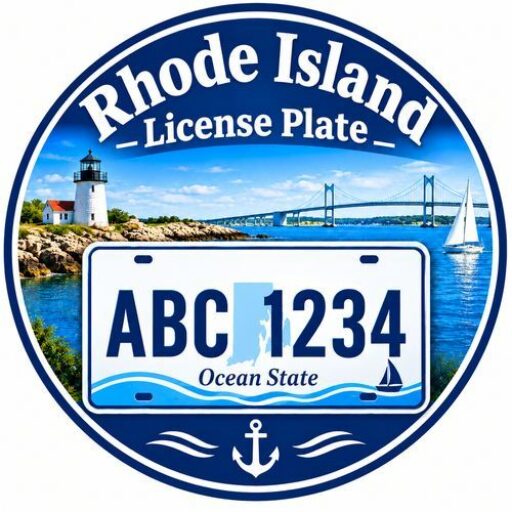
The current design arrived in 2023 and is easy to recognise. It carries a wave and an anchor, a white reflective background, navy characters and the slogan Ocean State, and it was designed by Willem Van Lancker of South Kingstown. A plate without those features is likely to be an earlier issue, even when the registration behind it is current. Design and validity are separate things. A car can carry an older plate and a valid registration, because a plate is replaced when it wears out or when the design changes, not automatically on a fixed date. The sticker and the registration record decide whether the plate is in use, not the artwork or the age of the blank.
Low numbers and family plates
A low-number plate under 5,000 carries local status in Rhode Island, and those plates are often older than the cars they sit on. The number has been held on a registration or passed down for years. It signals history rather than a recent issue, which is why it draws attention out of proportion to its six characters.
Wear, reflectivity and replacement
An older plate also shows its age physically. The reflective surface dulls, the characters lose contrast and the edges begin to lift. A plate that no longer reads cleanly at night is a replacement case, and a remake is intended to keep the same number where the record allows it, rather than issuing a fresh one.
Specialty designs and the same character rules
A specialty plate changes the picture, not the string. The Sailboat plate design, the Antique plate and the charity plates offered with organisations such as the Atlantic Shark Institute, Rose Island Lighthouse, Rocky Point and Gaspee Days all carry a number in the same field. The design sits around the characters, not inside them. That matters when a plate is read or reported. The design can make a plate memorable, and it can hide a character if the artwork runs close to the field. The number itself follows the rules of its class, so a specialty passenger plate still carries the passenger count and a specialty motorcycle plate still carries the shorter one.
Antique and year of manufacture
Antique plates and year-of-manufacture plates are their own category, and they are read like any other plate when the number is recorded. The design difference is obvious, the character rules are not. A reader who assumes an antique plate must carry a certain number of characters is guessing, and the record is the only reliable answer.
What a plate number does and does not tell you
A plate number identifies a registration record. It tells the state which class the vehicle belongs to and gives it a way to match the plate to a title, an insurance check and a renewal date. That is the whole of its job, and it does that job without encoding anything a driver would recognise from the street. It does not give you the owner’s name, address or driving history. It does not prove that the vehicle is insured, inspected or paid for, and it does not confirm that the person selling the car holds the title. Those questions sit in separate records that a plate lookup does not reach, however specific the number looks.
What the characters are not
The characters are not a date code, a county code or a price band. A reader cannot work out the model year from the number, and a low number is not proof of an early registration on its own. Treating the string as a hidden code produces confident guesses, and those guesses are usually contradicted by the first record check.
Where to confirm a record
The public lookup at ridmvservices.ri.gov returns registration status for a plate. Anything beyond status, including a title question, an insurance gap or a lien, needs the DMV or the insurer rather than a number read from a bumper. A plate is the starting point for a check, never the answer to one.
How to copy a plate number correctly
Copying a plate is a small skill with a large failure rate. Read it in daylight, left to right, one character at a time, and write the string without inserting spaces or punctuation. Then read it back against the plate rather than against what you expect, because expectation is what turns an eight into a B and a five into an S. Note the plate class while you are there. A passenger plate copied onto a form for a commercial vehicle will fail even when the characters and plate design are correct, and the same applies to a motorcycle plate entered as a car. Record the state as well, since a Rhode Island plate checked against another state’s system returns nothing.
Photograph rather than memorise
A photograph taken square-on, in shade rather than direct sun, is more reliable than memory. Check the image before you walk away, because glare and angle hide characters that look clear to the eye. If the plate is dirty or damaged, wipe it or note the damage, since a partial character will fail a lookup and send you looking for the wrong record.
When the plate and the paperwork disagree
If the registration certificate and the plate show different strings, stop and ask the DMV which one is right. A mismatch usually means a replacement plate was issued and the certificate is older, or a character was typed wrongly when the record was created. Neither problem fixes itself, and driving on the wrong one invites a stop.
Plate class and character limits
The table below collects the published limits by class. The standard rows describe what the DMV issues today, and the vanity rows describe the narrower format that personalised plates follow. Read the class first, because the limit belongs to the class rather than to the size of the vehicle carrying it.
| Plate class | Character limit | Notes |
|---|---|---|
| Passenger, standard | Six characters | Letters and digits in a single field, no spaces |
| Motorcycle, standard | Shorter than a passenger plate | Smaller blank, fewer positions |
| Commercial under 9,001 lbs | Six characters | Own class, annual renewal in March |
| Vanity passenger | 2 to 6 letters, or up to 6 letters and numbers | New applications paused since February 2021 |
| Vanity motorcycle | 2 to 5 characters | Same pause applies to new orders |
A limit is not a target. A short combination is legal on a class that allows more, and the DMV does not pad a number to fill the field. What matters is the exact string, including every leading character, because a dropped digit changes the record and may land on an unrelated vehicle.
Frequently asked questions
These are the questions that come up most often from drivers copying a plate, comparing an old one with a new issue, or trying to work out whether the characters mean something. Each answer sticks to what the DMV publishes, and none of them depend on reading a hidden code into the string.
Do all Rhode Island plates have six characters?
No. Six characters is the standard for a passenger plate, and a motorcycle plate is shorter because the blank is smaller. Vanity plates follow their own limits, 2 to 6 for a passenger and 2 to 5 for a motorcycle. The class decides the count, so a plate cannot be judged by length alone.
Can I choose the letters on a new plate?
Not currently. The DMV stopped accepting new vanity applications in February 2021, after a federal court ruling. Existing vanity plates continue to renew, and their characters stay with the registration. A standard plate is assigned from the series held for its class, with no applicant choice.
Why does my motorcycle plate have fewer characters?
The plate is physically smaller, so it holds fewer positions. That is also why the vanity limit for a motorcycle is 2 to 5 rather than the 2 to 6 allowed on a passenger car. The shorter string is normal, and a form that expects six characters will reject it unless the class is set correctly.
Are spaces or hyphens ever part of a number?
No. The field holds letters and digits only, and any gap you see is spacing rather than a character. A dash or dot printed on the plate belongs to the design. Typing a space or a hyphen into a lookup is the most frequent reason a correct plate returns no record.
Does a low plate number mean the car is old?
Not necessarily. A number under 5,000 carries local status in Rhode Island and is often held on a registration for years, so the plate may be much older than the vehicle. The reverse also happens, with an old plate moved onto a newer car. Only the record settles it.