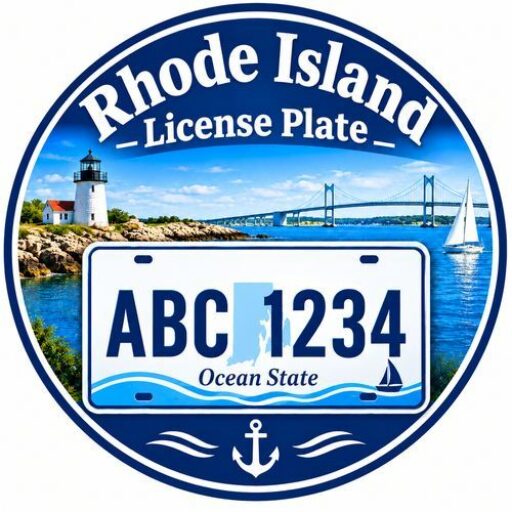
A Rhode Island vanity plate is a standard passenger plate carrying your own combination of letters and numbers instead of the state-issued sequence. The plate itself keeps the Ocean design, with the wave, the anchor and the same navy lettering, so the only thing that changes on the car is the six characters at the centre. Motorcycles and commercial vehicles can be personalised too, within shorter limits, and the character ceiling differs by class.
The programme has been closed to new applications since February 2021, and that single fact shapes everything on this page. What follows is the exact ordering process from the Division of Motor Vehicles, the current fees from the published plate table, the character limits for each vehicle class, and what existing vanity plate holders can still renew or transfer today without waiting for the pause to end.
How to get a Rhode Island vanity plate
The process runs through the state’s online reservation service rather than the counter, and it has not been withdrawn even though intake is paused. When the programme reopens, this is the sequence the DMV expects applicants to follow.
When the programme is open
Orders are placed online, paid by card, and reviewed before the plate is manufactured. The registration appointment happens after the combination clears, not before it.
- Choose a combination inside your vehicle class limit
- Select the design, either Standard Ocean or the optional Sailboat
- Pay the plate fee with a Visa, Mastercard or Discover card
- Wait for the combination to clear review
- Book the registration appointment and collect the plates
The reservation service covers passenger vehicles, motorcycles and commercial vehicles under 9,001 lbs.
Official source: https://dmv.ri.gov/registrations-plates-titles/license-plates/plate-types/vanity-plates
What to have ready
The vehicle has to be titled in Rhode Island and the registration current or in progress. Bring photo identification and proof of insurance to the appointment, because the Rhode Island License Plate is attached to the registration record rather than kept as a separate item. A leased vehicle needs written authorisation from the lessor before a personalised plate is assigned. Financing does not create the same obstacle, since the lender holds the title rather than the registration.
- Photo identification
- Proof of Rhode Island insurance
- Title or Manufacturer Certificate of Origin
- Lease authorisation, where the vehicle is leased
Missing paperwork is the usual reason a plate appointment ends without a plate. A second visit costs another slot in a queue that fills fast around the end of the month.
What the appointment covers
The counter visit is a registration transaction, not a plate transaction. Staff confirm the title, the insurance and the class, then issue the registration that carries the new plate. The plate fee was already paid online, so the only money changing hands at the appointment is the registration charge and any transfer fee. Timing runs in weeks rather than days. Review happens before manufacture, manufacture happens before the appointment, and the appointment depends on availability in Cranston.
If the combination is refused
A refusal is not the end of the process. The DMV contacts the applicant, offers the chance to submit a different combination, and refunds the plate fee if no alternative is agreed. Refusals are not published, so there is no list of banned combinations to check against in advance. The safest approach is a combination that reads clearly as a word or a name. Anything that could be read as a message is the kind of submission that draws a review. A refused combination does not affect the vehicle registration, and the car keeps its current plate until a replacement clears. Resubmitting costs nothing beyond time, and the appointment is only booked once a combination clears.
Can you still order one today?
No. The Division of Motor Vehicles states on its vanity plate page that it is not currently accepting new applications. Anyone submitting a combination today is not added to a queue, and no waiting list has been published.
What the DMV notice says
The published notice sits above the reservation instructions and has not changed in years. The instructions remain online because the same page serves existing holders and staff processing renewals, which is why the portal still loads. The form works, the character rules are published, and the fee table is current, so a reader can be forgiven for assuming the programme is open. The notice is the only line that answers the question, and it is the first thing to check before planning anything around a combination.
What would have to change
Reopening needs two things that do not exist yet. The state has to publish an approval standard that survives the court ruling, and the DMV has to restart intake with a process for reviewing combinations. Neither has a date attached. Two paths are possible. The DMV can write an administrative standard, or the legislature can put one into statute. The second route takes longer but is harder to reverse, which is why it keeps coming back as a bill.
What a Rhode Island vanity plate allows
The format rules were written per vehicle class, and they are the part most people get wrong when they plan a combination in advance. Passenger plates get the most room, motorcycles the least, and commercial vehicles sit in between. The table further down sets out each limit, and the design options are narrower than most drivers expect.
Passenger vehicles
A passenger vanity plate can be any combination of two to six letters, or up to six letters and numbers. Six characters is the ceiling, not a target, so a three-letter plate is valid and often easier to read at a distance. Spaces are not part of the combination, and neither are symbols or punctuation. The six-character ceiling comes from the standard plate format, which is why a seven-character idea cannot be squeezed in by using a smaller font.
Motorcycles and commercial vehicles
Motorcycles are limited to two to five letters and numbers. Commercial vehicles under 9,001 lbs follow the passenger rule of two to six, and the same combination cannot already be registered to a passenger car, motorcycle or another commercial vehicle. A shorter combination is not a downgrade. Motorcycle plates are physically smaller, and five characters fill that space the way six fill a passenger plate, so a combination planned for a car often has to be trimmed before it can be issued on a bike.
| Vehicle class | Character limit | Design options |
|---|---|---|
| Passenger | 2 to 6 letters, or up to 6 letters and numbers | Standard Ocean, optional Sailboat |
| Motorcycle | 2 to 5 letters and numbers | Standard Ocean |
| Commercial under 9,001 lbs | 2 to 6 letters and numbers | Standard Ocean, optional Sailboat |
| Antique vehicle | Follows the antique plate format | Antique vanity design |
Designs you can choose
Initial orders are limited to the Standard Ocean plate, the optional Sailboat design, or the Antique design for qualifying vehicles. A vanity combination cannot be applied to a charity plate or to another specialty design, and the restriction matters on a used car, where an existing charity plate cannot be converted. The design choice is permanent for the life of the plate. Changing from Ocean to Sailboat later means a remake and a new fee, so the decision is worth making at the order stage rather than after the plate has been issued.
Antique vanity plates
Antique vehicles can carry a vanity plate, but the plate follows the antique registration rules rather than the passenger rules. That means restricted use, an inspection exemption that does not extend to daily driving, and a format tied to the antique series. Anyone planning an antique vanity plate should confirm the vehicle qualifies before choosing a combination, because the registration class decides whether the plate can be issued at all. Antique plates are also the one class where the vanity route and the year-of-manufacture route are often confused. A year-of-manufacture plate uses an original plate from the vehicle build year, while an antique vanity plate uses a new plate with a chosen combination.
What a Rhode Island vanity plate costs
Two charges apply. The plate itself is a flat fee paid at order, and the registration is charged separately by weight when the plates are collected. Existing holders pay a vanity surcharge on every renewal.
Initial order fees
Every figure below comes from the DMV plate table and includes the technology surcharge.
| Plate and class | Initial fee |
|---|---|
| Vanity plate, Ocean, passenger | $69.50 |
| Vanity plate, Sailboat, passenger | $83.50 |
| Vanity plate, Ocean, motorcycle | $43.50 |
| Vanity plate, Ocean, commercial under 9,001 lbs | $69.50 |
| Vanity plate, Sailboat, commercial | $83.50 |
| Vanity plate, Antique | $69.50 |
Renewal fees
Vanity renewals cost more than standard renewals because a surcharge is added to the normal registration charge rather than replacing it. On a passenger vehicle the surcharge is a fixed amount across the two-year cycle, and the weight-based registration and DOT surcharge are added on top. Motorcycle vanity renewal is a fixed figure for two years, made up of the standard renewal plus the vanity plate fee. There is no weight component on a motorcycle, so the figure does not move. Additional registration and transfer fees are due when the plates are collected. The order fee reserves the combination, and over ten years the surcharge costs more than the initial order does. Payment is by card on the online service. If the combination is refused and no alternative is agreed, the plate fee is refunded, but a plate that has already been manufactured is not.
What the fee does not cover
The plate fee covers the plate. It does not cover the registration, the title, the sales tax on the vehicle or the inspection. On a first registration those charges usually exceed the plate fee, which is why budgeting from the plate table alone gives a misleading picture.
Vanity plates vs standard and specialty plates
Three plate types get confused constantly, and only one of them is frozen. The differences between the plate types are in who can order, how the characters are set and what the plate costs to keep. A standard plate, a charity plate and a vanity plate all carry different rules, and only the vanity plate gives you a say in the number itself.
| Type | Characters | Open to new orders | Initial fee |
|---|---|---|---|
| Standard plate | State-issued sequence, six characters | Yes, with every registration | Included in registration |
| Vanity plate | Your combination, 2 to 6 characters | No, paused since February 2021 | $69.50 to $83.50 |
| Charity plate | State-issued sequence on a charity design | Yes, ordered through the DMV or the charity | $43.50 |
A charity plate changes the design while the number stays random. A vanity plate changes the number while the design stays standard. A standard plate changes neither, which is why the surcharge only appears on one of the three. Choosing between them comes down to what you actually want. A different number needs the vanity programme. A different look needs a charity design. Neither changes the registration class or the renewal date. Resale is the practical difference. A vanity plate adds nothing to the value of a used car unless the buyer happens to want that combination, while a charity plate travels with the vehicle at no extra cost.
Existing plates, renewal and transfer
Holders are unaffected by the pause. The plate keeps its combination for as long as the registration stays active, and it renews on the normal two-year cycle. What changed in 2021 is limited to new intake. Renewal cycles, transfer rules and the fee table all stayed the same, so a plate issued in 2019 behaves exactly like one issued in 2015. There is no re-registration stage, no new fee category and no requirement to swap the plate for a standard design.
Renewing a vanity plate
Renewal works like any other registration, with the surcharge added. The notice shows one combined figure, so the vanity portion is not itemised, and paying it keeps the combination attached to the vehicle. Cancellation is the risk that matters. A lapsed registration can be reinstated, but a cancelled vanity plate loses the combination, and the number returns to the pool. A damaged plate is the cheaper problem. A remake keeps the same combination and does not touch the registration, so a bent or delaminating vanity plate can be replaced without re-entering any queue. Renewal follows the same order every cycle, which makes it easy to plan.
- The notice arrives in the renewal month, set by the first letter of the surname
- The vanity surcharge is folded into one combined figure
- Payment keeps the combination attached to the vehicle
- A missed window can cancel the plate and release the number
Transferring a vanity plate
A vanity plate can move to a replacement vehicle you own, provided the class matches and the registration stays active. The transfer is recorded at the DMV, the standard DMV fees include a transfer charge, and the combination does not change hands independently of the vehicle. That matters in private sales. Rhode Island does not sell vanity numbers as separate licences, so anyone offering to sell you a combination on its own is selling something the DMV does not recognise.
When the vehicle is sold
If the buyer keeps the registration, the plate can stay with the car. If the registration is cancelled, the plate returns to the DMV and the combination goes back into circulation. A seller who wants to keep it has to transfer it to another vehicle before the sale completes.
Moving out of state
The combination belongs to a Rhode Island registration. Once the vehicle is titled elsewhere, the plate comes off and the number returns to the pool. No mechanism holds a combination in reserve for a driver who might return.
What to do while the programme is closed
The vanity route is shut, but the DMV still issues distinctive plates through two other routes, and both are open today. Neither replaces a personalised combination, but both put something other than a random sequence on the car, and neither involves a review process or a waiting list. Both can be arranged at the same counter visit that handles a registration or a transfer, which makes them the practical choice for anyone who wants a plate that looks different without waiting for a programme that has no reopening date.
Charity plates
Every charity design in production is open to a registered passenger vehicle. The order carries a flat fee, part of it goes to the organisation, and the number stays state-issued, so there is no review of combinations and no waiting list. Ordering takes three stages and needs nothing from the vanity programme.
- Pick a design from the DMV charity list
- Order online or through the charity itself
- Keep the existing registration and plate number
Turnaround runs to a few weeks, because the plate is manufactured after the order clears. The registration stays valid throughout, so there is no gap in cover while the new design is being made.
Low number plates
Low numbers trade with vehicles rather than on their own. A number under 5,000 carries local status, and the plate moves when the registration transfers. It is the closest thing to a personalised plate still available, though the price is set privately rather than by the DMV. Anyone buying a low number should confirm the plate transfers with the registration before paying, because a number attached to a cancelled registration returns to the pool with no refund.
A standard plate with a readable number
Not every distinctive plate is personalised. A standard plate carries no surcharge and renews at the normal rate, and the sequence is issued in order, so the number is a matter of timing rather than choice. It is also the only option that can be arranged on the same day as a new registration, because nothing has to be manufactured or reviewed first.
Frequently asked questions
These come up most often from drivers who assumed the programme was still open, usually after reading a generator site or a post in a local group. The answers below reflect the position published by the Division of Motor Vehicles rather than the advice circulating online, and they apply to passenger, motorcycle and commercial classes alike.
Can I get a vanity plate in Rhode Island right now?
No. New applications have been suspended since February 2021, when the DMV stopped intake after a federal court ruling on the state review of offensive combinations. No reopening date has been published and no waiting list exists. A site offering to submit an application today is not working through an official channel.
How many characters can a Rhode Island vanity plate have?
Two to six letters on a passenger plate, or up to six letters and numbers mixed. Motorcycles allow two to five. Commercial vehicles under 9,001 lbs follow the passenger limit. Spaces, hyphens and symbols are not allowed, and the ceiling comes from the standard plate format rather than a choice by the DMV.
How much does a Rhode Island vanity plate cost?
Initial cost depends on the design and the vehicle class, with the Ocean design cheaper than the Sailboat. Renewal adds a surcharge to the normal two-year registration charge rather than replacing it. The exact figures are in the fee table above, and registration is charged separately by weight when the plates are collected.
Can I transfer my vanity plate to another car?
Yes, when the registration stays active and the replacement vehicle is in the same class. The plate moves with the registration rather than as a separate item, and the transfer is recorded at the DMV. Moving out of state ends it, because the combination belongs to a Rhode Island registration.
Do existing vanity plates have to be surrendered?
No. Existing plates renew and transfer normally. The pause blocks new applications only, so a plate issued before 2021 keeps its combination for as long as the registration stays active. A cancelled registration is the one thing that returns the number to circulation.